
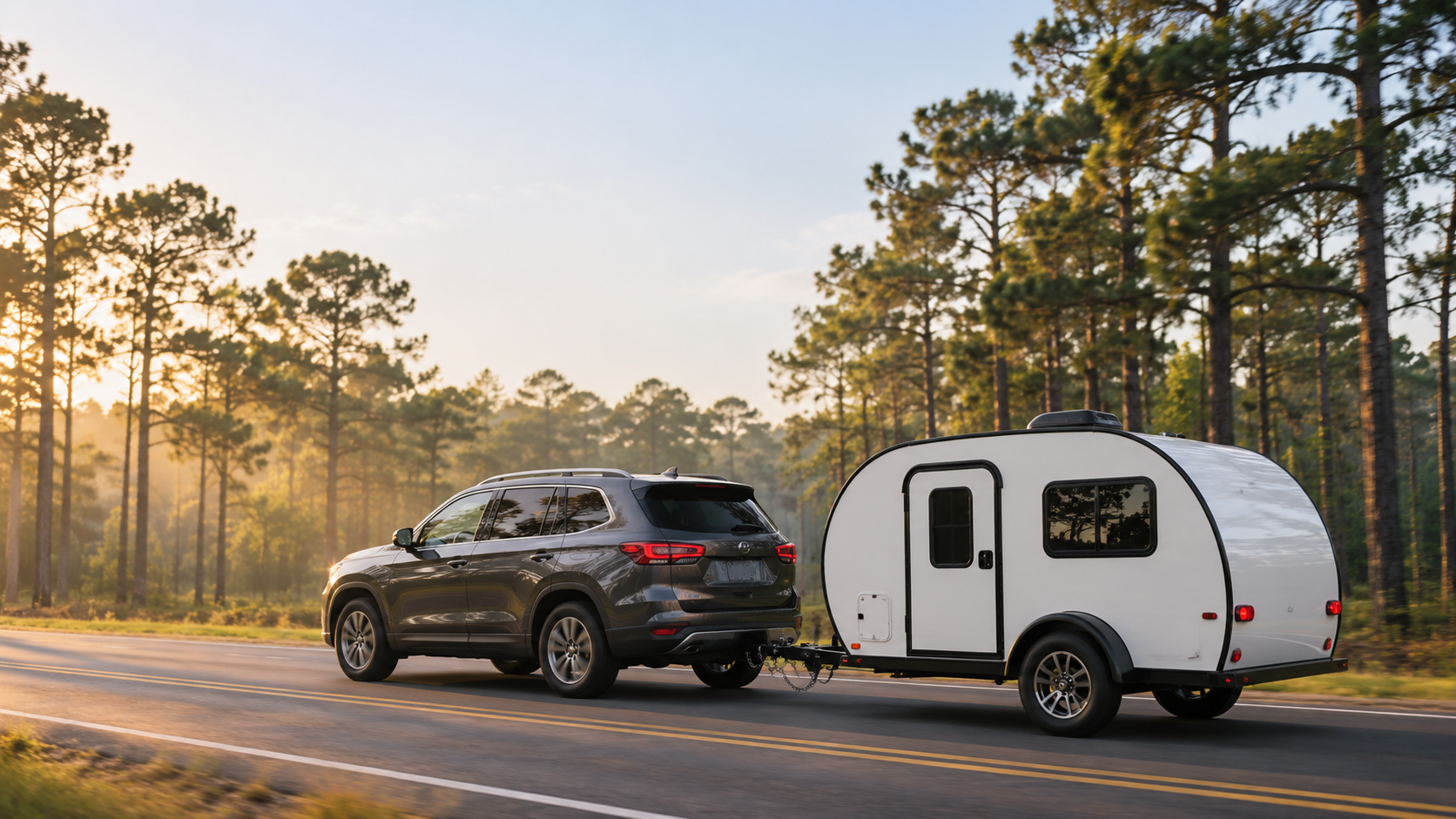
What is the best lightweight travel trailer I can tow with an SUV?
The best lightweight travel trailer to tow with an SUV is one whose fully loaded weight stays at or below about 80 percent of your SUV’s tow rating. For most mid-size SUVs, that means teardrops, A-frames and compact travel trailers with dry weights under 3,500 lbs, such as the nuCamp TAB, Aliner Evolution and Encore VENU. Your owner’s manual sets the final limit.
That 80 percent figure leaves room for water, gear and passengers, which all count once you hit the road. The sections below explain how to read your SUV’s numbers, which trailer styles fit, and what to check before you buy. Shoppers around Atlanta, LaGrange and the Georgia coast will find examples from the Southland RV lineup throughout.
How much weight can an SUV tow?
Most mid-size SUVs and crossovers are rated to tow between roughly 3,500 and 5,000 lbs, and many full-size SUVs rate higher. Your exact number depends on the engine, drivetrain and whether the SUV has a factory tow package.
The tow rating is a ceiling, not a target. It assumes a certain load in the vehicle, so every passenger and every cooler in the cargo area eats into the margin. Tongue weight matters just as much. On most travel trailers it runs about 10 to 15 percent of the trailer’s loaded weight, so a 3,000 lb trailer can put 300 to 450 lbs on your hitch. That weight counts against your SUV’s payload.
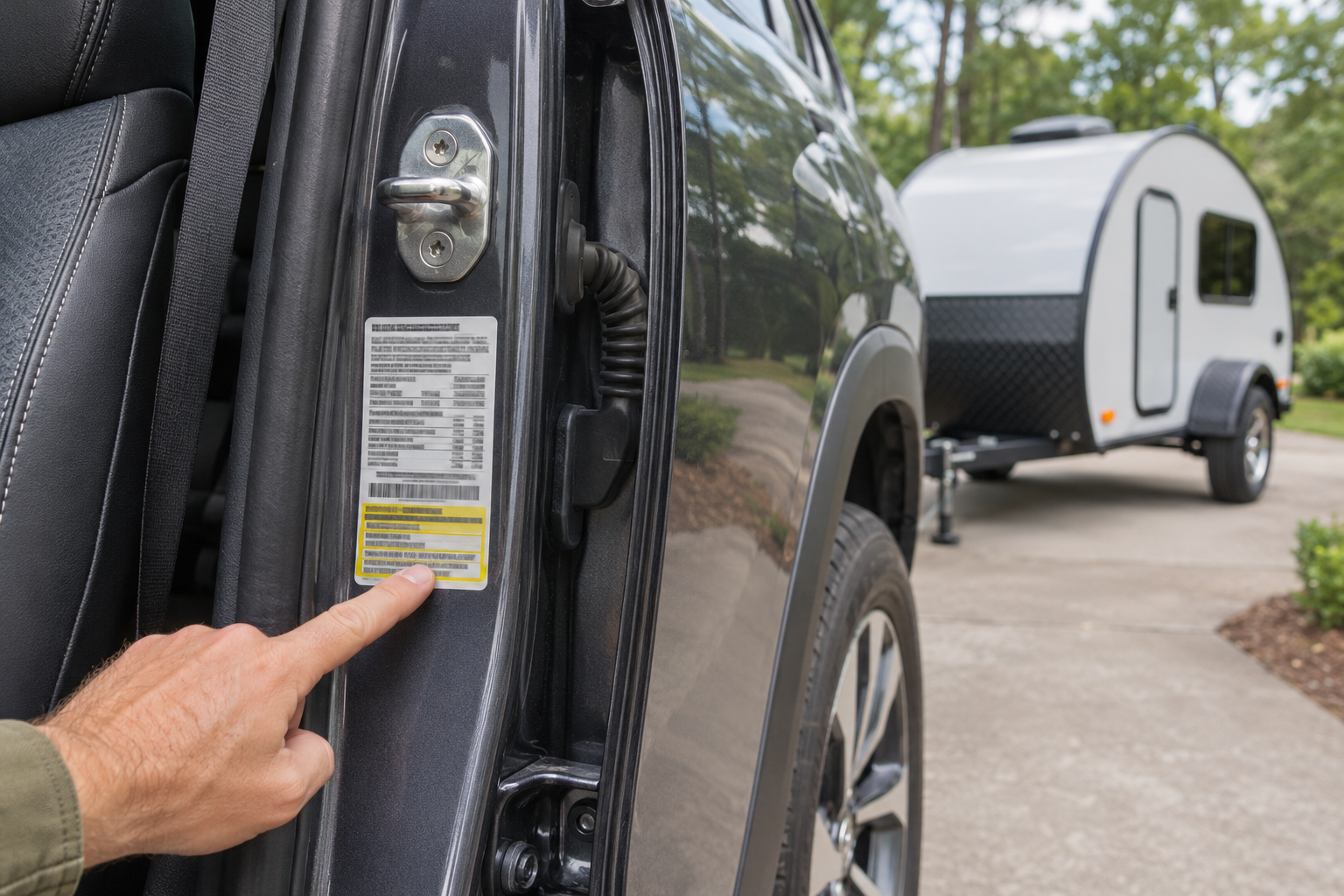
You will find the tow rating and payload in your owner’s manual and on the sticker inside the driver’s door jamb. Write both down before you start shopping. Southland RV also has an online tow guide where you can look up your vehicle by year, make, model and trim. It is a reference tool, so confirm the result against your manual.
What counts as a lightweight travel trailer?
There is no official definition, but in practice a lightweight travel trailer has a dry weight under about 3,500 lbs and a short, narrow body that a mid-size SUV can handle.
Dry weight is the number manufacturers publish for the trailer as built at the factory. It does not include fresh water, propane, batteries or anything you pack. Water alone weighs about 8.3 lbs per gallon, so a 20 gallon tank adds roughly 166 lbs when full. Add bedding, a camp stove, chairs and food, and the real number climbs by several hundred pounds.
For a conservative match, compare your SUV’s tow rating to the trailer’s GVWR, the maximum loaded weight printed on the trailer’s sticker. If the GVWR fits under your 80 percent target, you will not have to worry about how well you packed.
Which lightweight trailer types work best behind an SUV?
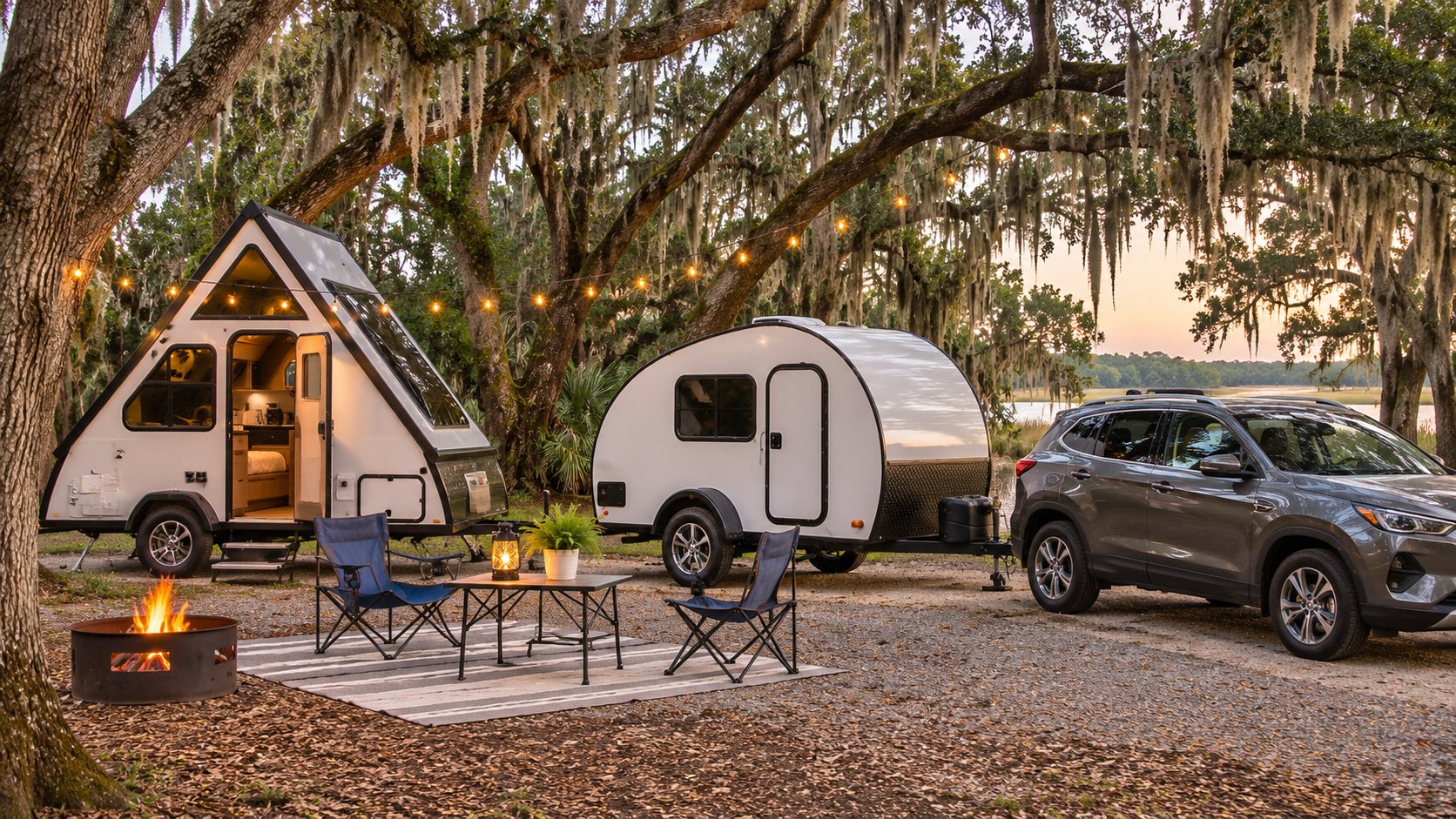
Teardrops, A-frames and compact bumper-pull travel trailers are the three styles that suit SUVs best. Each trades interior space for easier towing.
Teardrop trailers are low and narrow, with a small frontal area that cuts wind drag. Current Southland RV listings include the nuCamp TAB 360 at 2,605 lbs dry, the nuCamp TAB 400 at 2,885 lbs dry and the Modern Buggy Country Born CB16 at 2,850 lbs dry.
A-frame campers fold down for towing and storage. The Aliner Evolution 15 is listed at 2,400 lbs dry, which puts it within reach of many smaller SUVs.
Compact travel trailers add more floor space. The Encore VENU 14TB Overland Package lists at 3,138 lbs dry, the East to West Della Terra 15BH at 3,149 lbs and sleeps five, and the inTech Sol Dawn at 3,300 lbs. The Airstream Caravel 16RB (3,450 lbs) and Basecamp 20X (3,500 lbs) sit at the top of this range.
Weights and availability change as units sell, so treat these as examples and check the campers under 3,500 lbs page for what is on the lot now. Truck campers appear on that page too, but they ride in a pickup bed, so skip them if you drive an SUV.
What is the difference between a lightweight trailer and a standard travel trailer?
A lightweight trailer is smaller, lighter and easier to tow, but it sleeps fewer people and carries less water and storage. A standard family travel trailer gives you a bigger kitchen, a separate bunk area and more storage, at a much higher weight.
The step up is bigger than many shoppers expect. A used Flagstaff Micro Lite 22FBS lists at 5,132 lbs dry, and a new Grand Design Imagine XLS 22MLE lists at 5,358 lbs dry. Once loaded, trailers like these call for a vehicle with a tow rating well above what most mid-size SUVs offer.
Pros of staying light: lower fuel use, easier backing and parking, a better chance of fitting in a garage or side yard, and a wider choice of tow vehicles. Cons: tighter living space, smaller tanks and fewer amenities. If you camp with two adults and a dog, the trade is usually easy. If you camp with four kids, check sleeping capacity before you check anything else.
How do you choose the right trailer for your SUV?
Start with your SUV’s numbers and work toward the trailer. Do not fall for a floorplan first and then try to make the math work.
Find your SUV’s tow rating, payload and hitch rating in the owner’s manual and door jamb sticker.
Multiply the tow rating by 0.8. A 5,000 lb rating gives you a 4,000 lb loaded target.
Compare that target to the trailer’s GVWR, not its dry weight.
Estimate tongue weight at 10 to 15 percent of the trailer’s loaded weight and confirm it fits within your payload after passengers and cargo.
Confirm the hitch class, wiring connector and brake needs. Ask the dealer whether your setup calls for a weight distribution hitch or a brake controller.
Walk the trailer in person. Check the bed size, the kitchen layout and the height of the door against the people who will use it.
Georgia drivers should think about terrain as well. North Georgia mountain grades, summer heat and Atlanta interstate traffic all push a tow vehicle harder than flat, mild roads do. A trailer that sits comfortably under your limit is easier to live with on those routes.
What should you know about owning a small trailer?
Lightweight trailers need less upkeep than large ones, but they still need regular attention. Check tire pressure and tire age before every trip, since trailer tires age out even when the tread looks fine. Have the wheel bearings and brakes inspected on a regular schedule. Look over the roof and window seals at least once a year, because water damage costs far more than a tube of sealant.
Storage is a quiet advantage. Many small trailers fit in a driveway or garage, which saves monthly storage fees. Insurance, registration and financing vary by unit and by state, so ask for exact figures on the specific trailer you want.
What mistakes do SUV owners make when buying a travel trailer?
Most problems come from shopping by feel instead of by numbers. These are the ones we see most often:
Shopping by dry weight and forgetting that water, gear and propane add several hundred pounds.
Pushing the SUV to its maximum rating. It might pull the load, but braking and highway stability suffer.
Ignoring tongue weight and payload, which can run out before the tow rating does.
Assuming every SUV can tow. Some crossovers have low ratings or no factory tow package.
Buying for the one big trip a year instead of the twelve weekends you will really use it.
Skipping the hitch and brake setup until after the sale.
If you are unsure about any of these, bring your SUV’s door jamb sticker to the dealership. A five minute conversation with the numbers in hand beats an hour of guessing.
How can Southland RV help you find a lightweight travel trailer?
Southland RV has three Georgia dealerships: Norcross (Atlanta area), LaGrange and Richmond Hill (Savannah area). Units move between stores, so call ahead to confirm that a specific camper is on the lot before you drive over.
Bring your SUV’s tow rating, payload and tongue weight limit, and the team can match them against any unit in the lineup. Browse new travel trailers or used travel trailers, or look at brand pages for nüCamp, Aliner and Airstream.
If you are paying for it over time, the financing page and pre-approval form let you set a budget first. If you have an RV to move on, ask about the trade-in program or consignment. After the sale, the service and parts department can handle upkeep and warranty work.
Frequently asked questions
What size travel trailer can my SUV pull?
Take your SUV’s tow rating and multiply it by 0.8 to find a safe loaded weight. A 5,000 lb rating points to a trailer with a GVWR near 4,000 lbs. Check payload and tongue weight too, since passengers and cargo reduce what the hitch can carry. Your owner’s manual has the official numbers.
Can a mid-size SUV tow a travel trailer?
Yes, if the trailer is light enough. Many mid-size SUVs are rated between 3,500 and 5,000 lbs, which covers most teardrops, A-frames and compact trailers under 3,500 lbs dry. Confirm that your SUV has the factory tow package, and compare the trailer’s loaded weight to your rating before you buy.
How much does a lightweight travel trailer weigh?
Lightweight travel trailers typically have a dry weight under 3,500 lbs. Teardrops on the Southland RV lot list between about 2,000 and 2,900 lbs dry, and compact trailers run from roughly 3,100 to 3,500 lbs. Add water, propane and gear, and the loaded weight will be higher.
Do I need a weight distribution hitch for a small trailer?
Often not for trailers under 3,500 lbs, but it depends on your SUV and the trailer’s tongue weight. Some manufacturers require one at a set weight, and some SUVs sag at the rear without one. Check your owner’s manual and ask the dealer to review your specific hitch setup.
What is tongue weight?
Tongue weight is the downward force the trailer’s coupler puts on your hitch ball. It usually runs 10 to 15 percent of the trailer’s loaded weight. Too little causes sway, and too much overloads the SUV’s rear axle and eats into payload. A tongue scale or a dealer can confirm the number.
What is the difference between dry weight and GVWR?
Dry weight is the trailer’s weight as built, with no water, propane or cargo. GVWR is the maximum loaded weight the manufacturer allows. Use GVWR when you match a trailer to your SUV, since it shows the heaviest the trailer can legally be once you pack it.
Where can I buy a lightweight travel trailer near Atlanta?
Southland RV sells new and used lightweight travel trailers at its Norcross location near Atlanta, and at its LaGrange and Richmond Hill stores. The campers under 3,500 lbs page lists current units. Call ahead to confirm a specific trailer is at the store you plan to visit.
Final takeaway
Start with your SUV’s tow rating, set aside 15 to 20 percent as a margin, and shop by loaded weight instead of floorplan. Teardrops, A-frames and compact trailers under 3,500 lbs dry fit that math for most mid-size SUVs. To see current options, browse the campers under 3,500 lbs or contact Southland RV and bring your SUV’s door jamb sticker. The team will help you match a trailer to your vehicle.